Showing posts with label Oregon Wilderness. Show all posts

Friday, April 3, 2009

Nettle Time -- Part 4, cooking

Now for the fourth and final installment about my first spring picking of Nettles -- recipes.

Here is the easy answer as to how to use fresh/parboiled nettles -- treat them like spinach.

Some recipes I tried were Nettle Quiche (top), and Sauteed Nettles.

The Nettle Quiche is very straightforward, I just used a basic quiche recipe and put some chopped, sauteed nettles into the mix with the cheese.


The Sauteed Nettles are simply onions cut thin, sauteed down until carmelized, then the parboiled, chopped nettles introduced into the pan with some salt and pepper and tossed until warm and coated with tasty onion oil goodness. The non-veg version is to cook bacon in the pan first, pour off most of the fat, keeping about 2 Tbs., then cook the onions and Nettles as above, but adding bacon bits into the mix. Mega tasty.

Although I used freshly-parboiled Nettles for the dishes pictured here, frozen ones work just dandy. The flavor is preserved, and if you were sparce with parboiling as I mentioned in Part 3, then the texture will be good as well.

The taste of the nettles was most apparent in the saute recipes, so if you are wanting to show off their unique flavor I'd go that route.

I found out that folks have been able to buy nettles at farmers markets lately, so you might want to check that option out if you don't have time to hit the woods but want to experiment with these greens.

Enjoy exploring wild foods this spring,

Bp

Monday, March 30, 2009

Nettle Time -- Part 3, freezing

Freezing is now my favorite way to store Nettles. The end product is versatile and super tasty.

Farmer Theo said that his frozen Nettles ended up weird, slimy and black. I was hoping that was due to over cooking, so my main goal was to parboil the nettles just long enough to make them edible, but not long enough to make the leaves break down. I succeeded.

This first picture is of my parboiling setup. I use a stainless steel stock pot with a pasta insert. I get the water (with a little salt added) to a roiling boil, full power, and dump the full pasta insert in with the nettles. I stir the nettles to make sure they're all exposed to the boiling water -- 30 seconds to 1 minute maximum. The closer to 30 seconds the better in my book.


Here is the finished parboiled product. Note the bright green stems and still-green leaves -- this is what you see when they are correctly boiled. None of the leaves are more than slightly wilted, and definitely none of them are a dark, blackish-green color. That is a sign of over-cooking.

At this point they are ready to eat, and we did eat plenty of them right out of the pot -- no salt, no butter no nothing. I really love the taste of these guys, it is like a flowery, mellow spinach flavor. Oh and here's something I learned the hard way -- don't store the newly-cooked greens in a big pile (say in a huge steel bowl) for very long, because they keep cooking and can over-cook. Spread them out to cool and get em bagged up as soon as you can.


For bagging up, I use a Food Saver Vacuum Machine. For the price it works dandy. You can see from the pictures that I leave a lot of empty space in the bags. That is because I re-use them if I've only stored vegtables in them. They are easy to clean (I throw them in the dishwasher -- mine doesn't have a heating unit in it to melt them) and the extra space keeps them a good useable size.

Anyway, there they are, labeled and dated and ready for the freezer. If vacuum sealed they should stay for 2+ years in the freezer. Having "only" picked 5 full grocery bags full of nettles (and drying 2 of them), we're almost out already. In my house at least, don't expect them to stay around too long.

In the 4th and final installment, I'll talk briefly about how I've used the fresh Nettles in cooking.


Enjoy storing up wild foods,

Bp

Monday, March 23, 2009

Nettle Time -- Part 1


Stinging Nettles (Urtica dioica)are some of the easiest to identify, most common, tastiest and most nutritious wild edibles in the Pacific N.W. And they're starting to pop right now.

In Washougal, Washington on the shores of the Columbia, the nettles I was picking late last week (with the help of Farmer Theo and Ms. Sara) were almost all under 1' tall. That's primo size for eating.

Identifying nettles is pretty easy, especially if you aren't afraid of a little pain. Look for herbs in wet forest ground that look like mint or verbena, and touch it with, say, your arm. If it flares up and stings and makes a rash where it touched you, bingo. A less painful way to I.D. them involves talking to experts and/or bringing them into the forest with you.

I always use gloves when I collect them, for obvious reasons. If you want to return to the same collection spot, cut them above a growth node and they'll come back bushy and tender in a few weeks from the same stalk.

There are many ways to use nettles, from cooking and eating as is, drying and using as a supplement or tea, and even making cordage. I'll talk about how we're going to be using them this season in later episodes of this post.

Enjoy eating something that formerly was just something you avoided when hiking,

Bp

Thursday, February 26, 2009

Luminescent Fungi in Japan (and elsewhere)


The Pink Tentacle blog has a great post about these awesome Japanese luminescent mushrooms (Mycena lux-coeli). Apparently, they grow on fallen Chinquapin trees.

These particular fungi are from deep in undisturbed woods, which are a pretty rare thing in Japan nowadays.

There are a few different varieties of mushies that will pull off this maneuver. We've observed some fungi in rotting wood in the woods on Mt. Hood that look like little glow worms. They were especially abundant on the path up to Angel's Rest in the Gorge, which is one of the reasons I used to like doing night hikes there.

Probably the largest specimen of glowing mushroom in the States is the Jack O' Lantern mushroom, Omphalotus olearius. As far as I know, they don't come this far north, but are pretty common in central and southern California.

Enjoy glowy things in nature that aren't ravers taking a night hike,

Bp

[via my faithful Canukistani operative "Yuri," photo credits at Rincon Del Misterio]

Thursday, December 4, 2008

Great cougar pictures via Trail Cam

These pictures were taken with a trail camera in the Blue mountains, SE corner of Washington State. I received them via email, and there is no attribution. I had to share them anyway, I just love these animals.

My fascination and awe of cougars probably has to do with having seen one up close and in the wild. They've enthralled me ever since.


Enjoy images you will probably receive via email any minute now,

Bp

[via Estu]

Friday, October 31, 2008

Major Herp sighting: Coast giant salamander , Dicamptodon tenebrosus


Look at that handsome Fella!

I was so excited when a mushroom picking friend spotted this "little dude" when we were in the woods. I had just walked past it, in fact. At first, I thought it was a Cope's giant salamander (Dicamptodon copei), but on closer inspection I do believe it was a Coast giant salamander (Dicamptodon tenebrosus). Make sure to click on the thumbnail photos to get a better look at this handsome dude(ette).

I call this a major herp sighting -- but that only applies to me and my excitement level. These guys aren't rare, but they can be rare to spot due to their reclusiveness and camouflage. "Real" herp experts in this region probably see them on a regular basis.

As amphibians go here in the NW, this guy definitely is a giant. Check out the size compared to my friend's hand. He was a good 10 - 12" long, and hefty. He didn't move a whit when we were surrounding him and talking and pointing and snapping photos. It was quite a sighting, I was very excited.

So, technically this is a "little dudes" post, but a Big Little Dudes one. If I weren't mushroom picking at the time, I'd tell you where I spotted him. As it is, you will have to pry the information from my cold, dead fingers.

Enjoy unusual wildlife sightings in our beautiful Pacific N.W. rainforests,

Bp

[photos by the lovely Alethea]

Friday, August 15, 2008

Take a bus to the coast


Did you know you could take a bus to Cannon beach, and then to Tillamook and then to Oceanside -- all on the same ticket? The Tillamook County Transportation District sells round trip tickets to the coast from Portland for $35. That ticket lasts you the day, and includes bipping around to Oceanside/Netarts, Manzanita/Cannon Beach, and Pacific City.

Be careful though, there is a rider alert -- check it out:

RIDER ALERT
All routes are running according to schedules.

Oh no, not that!

I love it.

Enjoy finding out ways to get out of town for uber-cheap,

Bp

[via RBrant]

Sunday, June 8, 2008

Native Oregon Carnivorous plants, and my friend The Marine


Here are a couple pictures of my beautiful Darlingtonia [looks like this is a Sarracenia actually, thanks for the heads up in the comments -- I'll keep the info on Darlingtonia up here regardless. Oh, and here is an awesome company Sarracenia Northwest, that has many carnivorous plants for sale], a carnivorous plant native to Oregon and California. My good friend The Marine, who sometimes posts here as Trappin' Pat, gave this to me out of his ever-increasing collection.

Darlingtonia are also known as Pitcher plans or Cobra lilies. I posted large pictures so you can see detail if you want to by clicking on the thumbnails of them. There is one pitcher open so far, the others are still maturing. And it's got a cool flower as well -- which is good to see since the pitchers are sometimes thought of as flowers, but really they are adapted leaves.

If you want to see them in the wild, there is a great wayside just North of Florence called the Darlingtonia State Natural Site. Here is another link from Planet Oregon on the wayside, and the Oregon State writeup about it.

My plan right now is to develop a dense shelf of potted carnivorous plants between my compost pile and my chicken run. They'll feast, it's going to be great. The Wife's got her orchids, I have my Darlingtonia.

ps/addendum: Forgot to mention, when I noticed that one of the pitchers was mature and open I peeked inside, and there already was an ant and a spider in there. It had only been open maybe a day or two -- too cool.

Enjoy bizarre plants and the loyalty they inspire,

Bp

Wednesday, June 4, 2008

Mega low tides inspire truancy, quest for aphrodisiacs


I'm ditching a class tomorrow, because the tide is going to be SO DAMNED LOW. I can't resist the chance to go out and walk up to rocks that I've always admired from shore, check out the wildlife on the rocks, and gather up some mussels, sea vegetables, and razor clams. Just bought my clam gun, and I'm going to head out at 0-dark-hundred tomorrow morning, license in hand, bucket, knife, scissors, and gun in tow.

Of course most shellfish are considered aphrodisiacs -- I need that like I need a hole in the head, but I thought it would be good to mention. Be warned, Portland.

Enjoy geeking out so hard you miss class,

Bp

[photo via Wikicommons]

Monday, February 25, 2008

Little Dudes: Clemmys marmorata -- Western Pond Turtle


There has been a turtle sighting at The Luddites' pond in The Shire. We are hoping (and descriptions indicate) that it was a Western Pond Turtle. These handsome little dudes are considered "sensitive" in Oregon, and are more rare as you head North. Eugene seems to be an oft-mentioned breaking point where the turtles begin to show a marked decline in numbers as you travel North.

The introduction of the locally destructive-yet-tasty Bullfrog (Rana catesbiana) is often noted as a major detriment to Western Pond Turtle populations in the West. Habitat destruction, as usual, is the most obvious and impactful element hurting this Little Dude though. Gigging up and eating some Bullfrogs (be sure of your identification if you choose to be a biological vigilante, which I highly encourage) sure wouldn't hurt.

So, time will tell -- The Luddite and Mrs. Luddite are quite excited about the prospect of rare animals on their property and have promised to keep me updated.

Enjoy the uncommon sightings,

Bp

Tuesday, January 22, 2008

Nutria, and why we should develop a taste for them


Here is a video from Discovery News quickly explaining what Nutria are, and why they are a problem invasive species. We have them in Oregon, and they're spreading. So far the best site I've found about them is Nutria.com from the Louisiana Department of Fish and Wildlife -- it gives biological, environmental, control, and culinary information.

In the South, they have bounties on their heads (tails actually) and are served in restaurants, after a quick naming face-lift to Ragondin (as they are known in France). My father, the big geek, ordered it when he was in New Orleans a few years ago and really enjoyed it. Ragondin certainly sounds more appetizing than a popular common name for them in the South of Swamp Rat.

I've got this thing about trying to create and encourage human exploitive markets for damaging invasive species. Having humans very interested in harvesting a particular animal or plant has in the past produced spectacularly decimating results -- why not apply this here and now? Make the next haute cuisine dish based on Ragodin -- create a run on the animals like we had on Redfish after Cajun cuisine became popular in the 1980's. I'm trying to develop plans for Starling-based "perfect nutrition wild-bird" catfood as well, but that's probably worth a post on its own.

By the way, Nutria Fur is fabulous -- similar in quality to Beaver. You know you want some guilt-free fur -- admit it.

Mr. Luddite might have Nutria in his mill pond, and if the water is clean (sure looks clean) they will become dinner in the near future. Expect a report.

[photo credit nutria.com website]

Enjoy your edible invasive species,

Bp

Thursday, January 17, 2008

Off to watch sea lions

I'm going to become deeply involved in the whole Sea Lion/Bonneville Dam/Salmon problem this term, and probably next. The crafty "C404" lion that kept figuring out how to get where he wasn't supposed to was one of the reasons this story got famous -- the other is the intense controversy surrounding the situation.

There is much to say about this, but beyond presenting the problem there's not much more I can say. Already, just being briefed about the situation, I realize how shallow the information I based my previous opinions on really was. That realization made it that much easier to just suspend opinion and gather data, and let the facts guide policy instead of sensationalist news or polarizing organizations without any local investment in the situation (had to bite my tongue, or typing fingers, not to link a few of the accused there).

As an example of the heatedness of the topic, I was out shopping for the final pieces of gear I'll need to do the work out at the Dam last night and ran right into it. Hard to find weatherproof, warm gloves that are thin enough you can write with them on. Anyway, I mentioned what I was getting the equipment for, and a thin, pimpled teen working the next aisle over said, "oh that about ruins my day... you are studying those things? I wish they'd just shoot them."

I mentioned that the situation is complex, and that one of the species of sea lions at the dam is endangered, so indiscriminate killing is really not a good idea. A few minutes later I heard we heard the kid mumble "I don't care if they're endangered, shoot em all." The salesmen helping me said, "he's just 18, so he gets a pass for being an idiot, we were all there once." This is true, but you can bet all his fishing buddies and probably his whole family feels the same way.


So I'm stepping into a bit of a cauldron here, but I'm excited to be doing direct observations of wildlife with intent to solve problems with the data. Real biology stuff, its exciting.

Time to pack it's gonna be colder than a well digger's ass out there.

Enjoy getting involved, even if it's not easy,

Bp

Tuesday, December 4, 2007

Largest Sitka Spruce in the U.S. succumbs to storms


This Sitka Spruce (also known at the Klootchy creek giant) is huge, and I just can't find pictures that give it justice. Apparently it snapped in half high above the ground during this week's storm, in high winds. It was a consistent stop for me on my way to the coast, and most Oregonians will have some memory to share about visiting it. A local news station took submissions of people's photos around the tree, which may give you some impression of it's grandeur.

This is one of the oldest living things in Oregon, and one of the biggest trees in the state as well. The tree was coming to the end of its natural life cycle, and showed signs of wear long before this storm finally snapped its trunk.

I'm very curious what will be done with the wood, the value is immense.

Sad to say goodbye to this giant being.

Enjoy your old relatives,

Bp

Thursday, November 22, 2007

Chanterelle-sicles anyone?

Went picking turkey day morning with Jon Schell, founder of the internationally famous Alethea Acupuncture Clinic in Northwest Portland. I had some blue cheese, thyme, chanterelle quiche to deliver tonight at the Foodie Orphan Turkey Day, and was out of yellow mushrooms. Good excuse to get out in the woods.

As you can see from this picture, it was cold. Plenty of frost on the logging roads, and some patches of snow on the ground. The dog didn't care, and we got into the mushrooms regardless. They were, however, frozen solid. It was kind of weird to be picking mushrooms, but not cutting them from the stalk, and every time you grabbed one it was rock hard. This would be the last mushrooming trip at these elevations (approx. 3500 ft., mostly south/southwest hillsides). Freezing really messes the mushrooms up, they're just water logged proteins, so freezing then thawing then freezing pretty much tears them apart. We went to an old faithful spot, crossing the stream at a really pretty spot. The frozen logs with snow weren't very easy to navigate but we got across with little incident. The logging roads took us into prime chanterelle habitat -- big trees, moss, and relatively undisturbed forest. The woods here had been logged of their biggest trees some time in the past, I'd guess the 50's, but it had been a selective logging. So as you worked through the trees, you'd occasionally find huge stumps, 6-7' in diameter. But, the trees they left behind thrived and are now reaing 2-3' in diameter themselves. The mushrooms have grown well in this stretch of forest. Here's a picture showing the disturbed, but highly mushroom-productive forest we were picking through.

The mushrooms being frozen made some extra steps to the cleaning process, affected their texture a little bit, but didn't diminish their flavor a bit. The quiche I brought to the potluck tonight were a huge hit, and I was more than pleased to be serving genuinely wild food that I had gathered myself. I love that shit.

Enjoy your little triumphs,

Bp

Friday, November 9, 2007

Luddite finds Kings on the coast

Received this image today over email from a very happy Luddite.
His spider sense got tingling and sure enough he found some Boletus edulus, or King Boletes, or Ceps, or Porcini.

I like many wild mushrooms for eating, but when I had these for the first time -- I hesitate to say this, but I think they blow most others out of the water.

(waits for lightning from the mushroom gods)

They all have their place and flavor and compatible dishes, but Ceps are just so dam good. Ok... Black Chanterelles are super tasty as well. And Matsutake have an incredibly unique and robust flavor... okok, it's apples and oranges. Beauty is in the eye of the beholder, all that rot. They're all good.

It's just I don't get Kings where I pick hardly ever. So, the grass is greener down the coast today.

I'll recover from this green, envious tinge momentarily.

Enjoy your friends' successes,

Bp

Monday, November 5, 2007

How to start picking wild edible mushrooms

I have a request from the comments! I feel so, official.

How do you start out collecting wild edible mushrooms if you don't have any friends with experience? I'd say, pay someone to be your friend -- I.E. take a class. The absolute best class I've ever taken was the Wild Mushroom Conference at Breitenbush Hotsprings. It was fantastic. There was a PhD for every 6-7 attendees the year I went, and I spiked up from picking Chanterelles only (!!) to having experience and confidence with over a dozen edible species. It's a bit of money and a bit of a time commitment, but I cannot possibly suggest it more highly.

Here's the heartbreaker, you missed it for this year. It is held mid-late October every year. The date floats a bit depending on availability of teachers.

If you have the patience, wait a year and go to that, I couldn't imagine a better start.

If you can't wait a year, hook up with the Oregon Mycological Society. I met many members when I attended the Breitenbush conference, and everyone was very sweet and helpful. They are so enthused about mushrooms that it is just contagious. There are some world-class mycologists who associate with this society, a fine fine group of folks. Their conference, also, was last month. But there are trips being planned all the time, and when you get in contact with them I'm sure you could find a mushroom outing just about any weekend of the fall season.

Bare bones: go out with PEOPLE who know what the hell they're doing. Don't rely on a book, ever. Some people would scoff at this comment, but this is my opinion. Why juggle around with danger like that, there's no need. There are scads of helpful folks who are more than willing to help you get started, just get a hold of them.

Oh, and absolutely buy David Arora's books, and other field guides. I keep his All that the rain promises, and more on me when I'm in the woods, and the huge tome Mushrooms Demystified in the car for deeper investigation. There are other good books out there but I prefer his, they are what I was weaned on.

Hope that helps, and if you have any questions just let me know.

Enjoy your newest hobbies,

Bp

Wild Edibles I did pick, post #2/2

A writing challenge to myself: finish this post before the Chanterelle Blue Cheese quiche is out of the oven -- go!

There were a few more dandy edibles that we picked while out last weekend. Two of them are in the Boletus family. I like Boletes for picking with beginning mushroomers because it has a safety built into it. If it has sponge instead of gills underneath, it's at least safe to pick and check out later (if there isn't a mentor around to check). The worst you get in the pacific N.W. is one that will slime up like a slug when cooked, or be bitter as hell and obviously inedible (big hint, when the bitter bolete is sliced with a knife the whole flesh section turns blue very quickly). So, relatively harmless compared to some of the other scary fungi out there in our forests.

The most abundant Boletus we ran across was Boletus zelleri. The magenta coloration on the stem, and the suede-leather-like brown cap are telling markers for this dandy little mushroom. It has conspicuous yellow sponge as well. Like all boletes, the bugs love em. Pick them young, and slice them in the field to make sure they aren't buggy (when is say buggy, what I really mean is maggoty, yech). They are great to eat, especially after they've been dried, with a strong enough flavor to hold up to mixed dishes and really beef up vegetarian soups and stews. They can often be found in the city, underneath large Doug Fir that are surrounded by mossy lawn. Of course you have to be sure the folks who tend the lawn don't use chemicals, and that dogs don't have access to the site. I've picked enough while driving around in an electrical van in the fall to make two large pizzas. It was great.

The next Boletus we picked, in much less quantity, was the Admirable Bolete or Boletus mirababilis. This handsome bolete grows out of rotting wood, has a slightly longer stem (generally) than the Zeller's, and doesn't have the magenta coloration on the stem. Otherwise, it is a pretty dam close look alike to the Zeller's. A nice thing when two look alikes are both tastey. I've found that when I am in old-growth forest, with plenty of rotting logs on the forest floor, and lots of moss, these can be the most conspicuous and abundant edible around. Again, since the bugs like them too, the take tends to be less than with Chanterelles, which bugs completely boycott. This is another good drying mushroom (all the Boletes are), and has a bit of a lemony flavor sometimes that is quite pleasant.

Finally, and on a completely different note, we picked Angel Wings -- Phyllotus porrigens. These are thin, translucent shelf mushrooms that like to grow especially on downed hemlock logs. They probably grow on other softwood logs as well. They are easy to identify, sometimes abundant, and often a nice look of variety in a mushroom dish. The flavor is delicate, and the texture sturdy/slightly rubbery. They won't melt in a saute pan which is nice. It's not an outrageously tasty mushroom, but it's great to add to a mushroom medley dish, and always fun to collect.

There we go, the last of this week's edibles. [general disclaimer coming, warning] Please do not use these posts as a guide to pick and eat mushrooms out of the woods. These posts are best used for fun reading, and backup material for use when you are in the woods with someone who knows their stuff. If any of my warnings about possible fungal poisonings sounded nonchalant, I didn't mean to come off that way. You really don't want to mess around with these guys as a mistake could end up being a huge one.

[all photo copyrights are credited in the text links for those mushrooms next to the photos in this page]

Enjoy your arboreal daydreamings,

Bp

Sunday, November 4, 2007

Wild Edibles I did pick Post 1 of 2


Figured a decent explanation of what I did pick and will enjoy eating from this week's picking trip was in order.

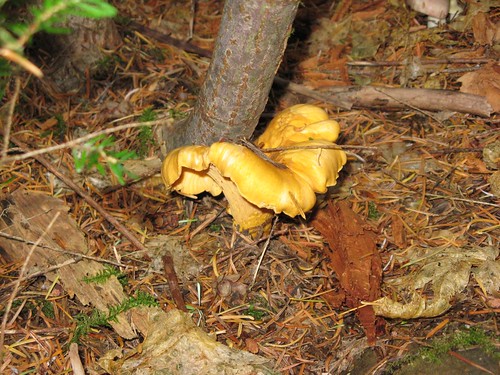
This first handsome mushroom is the famous Chanterelle (in this case, probably a Cantharellus formosus). A great beginner's mushroom, with few look alikes, bugs never invade them at all (an awesome trait that one realizes if you pick any Boletes, which get buggy quick), and just dandy for the table. Many would say that these are Cantharellus cibarius, even experts, and hell I won't argue with them. Fact of the matter is, they're both tasty and I'll take it. From a culinary standpoint, these are one of the world's favorite wild mushrooms. There are hordes of recipes (especially French) that use it.

I do know we run into a few other types of chanterelles in our pickings, and on this trip it was Yellowfoots, or Craterellus tubaeformis. The difference in appearance is subtle, but once you have been picking for a while it is easy to spot. Not worth wasting too many words on, as they too are tasty and I'll take em.

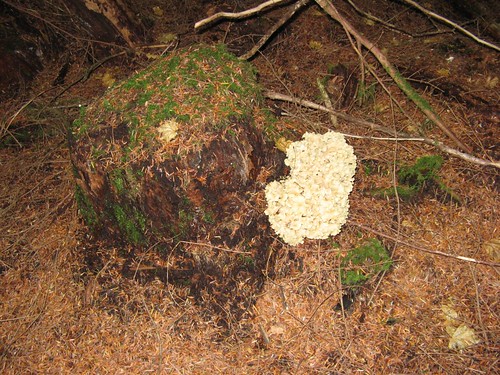
Next is the majestic Cauliflower mushroom, Sparassis cripsa. A big, impressive, easy to identify edible. It maintains an al dente texture even after long cooking, which some say is why the name includes "crisp." Always love to find these in good condition, the grand majority I've seen were past their prime and melting down. Always a sad sight. As a culinary mushroom, this one has an interesting texture and a nice bold mushroomy taste. Not flowery like the Chanterelle, but almost meaty. The shape and texture make it a great noodle replacement in Stroganoff recipies.

We found a nice little bunch of Honey Mushrooms, or Armillaria mellea growing out of the base of a Vine Maple. This is not a beginner's mushroom. It is brown (so many inedibles in the forest are brown, or "lbj's" -- little brown jobbies), and can be mistaken for a few other types of mushrooms. Once you get the spec's down, it becomes easy to figure out however, it just takes a trip or two with someone who is familiar with this species.
This is one of the mushrooms known to make some people a bit allergic/queasy depending on what substrate it grew on (since it always grows on or in a tree or rotting wood). It is always recommended for first timers to eat a few bites of this mushroom and then sit for a bit to make sure you aren't one of the people who react to it. I've eaten plenty of them to no effect so I collect them whenever I can. They can grow in impressively huge clumps, and make for quite a haul. For eating, the stems can be a bit stringy, but to me provide a nice textural quality. These mushrooms have a nice woodsy flavor, and are strong enough to hold up in mixed recipes.

We also found plenty of Shrimp Russula, Russula xerempelina. This is another "not a beginner" mushroom, as it has a look-alike that will make you puke, Russula emetica. Emetica often has a more candy-apple red cap, but the real test is virtually every Shrimp russula I pick I take a tiny bit, chew it up and let it sit on my tongue. Shrimps will be neutral, with possibly a tiny bit of pepperyness, but nothing major. Emetica will after a few seconds be incredibly hot, peppery, and bitter. It's not subtle. The reference guides love to talk about the shrimpy, fishy smell that these develop as something you can I.D. them with. In my experience, that smell only happens when they are really old and/or drying out. There is little to no smell on the young, succulent ones you will be picking. Take note of this fact, however, and if you have a dehydrator set up to dry a bunch of these, stick it outside or something, otherwise your house will smell like the bottom of a fisherman's dory in no time. Did that once and the house smelled for days. For cooking, they are mild and very tasty when fresh, sauteed like market mushrooms. But I think they are best used after drying, when their unique flavor is at its peak. Cream accents them well, so cream of mushroom soup is a good option for dried Shrimps.

Ok, it's late and I need sleep, that's enough info for one post. I'll finish off with some boletes and Angel's Wings in the next day or two.

Enjoy your wild culinary delights,

Bp

ps: I took the first two photos, and the second two come from the articles that I link to about that particular mushroom.

Saturday, November 3, 2007

Wild Edible mushrooms I won't pick, and why

Yesterday, the crew ran across a couple varieties of edible mushroom that I don't pick. In the process of writing this post, I realized that the reasons I don't pick them turn out to be pretty wishy-washy.

The first and most abundant is the Black Elfin Saddle, or Helvella lacunosa. Basically, I don't eat this one due to anecdotal evidence. I remember reading, or hearing somewhere, that if you ate a good amount of these and consumed alcohol, you could be temporarily paralyzed for about 24 hours. Harmless, but freaky. I, for the life of me, cannot find any reference to this "fact" anymore. So, I Have to chalk this up to superstition. Liamsdad is not saddled with these irrational fears, and collects and eats them with enthusiasm.

The second mushroom is a really handsome sucker called a Western Grisette, or Amanita pachycolea. It is very identifiable for someone with mushroom experience, it's supposed to taste dandy (despite what the Cali website says) and it would be another feather under my cap should I collect and eat it. But, you see, the term Amanita sends shivers up my spine. This is the family that sports both the Death Cap (Amanita phalloides), and the Destroying Angel (Amanita ocreata). Both of these mushrooms will take you out, dead, with one small serving. You may be saved with an organ transplant, but who wants to go through THAT hassle. I'd have to miss DAYS of school. So, I don't pick this handsome and tasty mushroom.

We found both on our last trip -- Liamsdad grabbed up the Elfin Saddles and I pointed out and talked about my fear of the Western Grisette and we left it at that. I figure, better safe than sorry, even if I can't find a single reference to back up my memory of temporary paralysis.

Enjoy your unfounded fears,

Bp

[Photo copyrights/credits: Elfin Saddle Mark Steinmetz; Western Grisette, Taylor F. Lockwood -- whom I've met, hell of a nice guy.]

Friday, November 2, 2007

Great Mushroom Hunt

Went into the Cascades with a few friends to gather mushrooms today. There are many other duties I could have canceled this trip for, but the wife encouraged me to just take a day off.

Liamspapa, his co-worker and friend Wes, Big Jon (of acupuncture fame), and Naboo the clinic dog were all in attendance. We worked our butts off, but the payoff was amazing. This might be the most diverse haul of mushrooms I've come out of the woods with. I'll talk specifics regarding the species of mushrooms we gathered in a later post, lets get into some pictures for now.

My first full basket of the trip, with chanterelles, boletus, angel wings, shrimp russula, elfin saddle, and honey mushrooms.


Liamspapa with some Chanterelles and Wes looking in.


Big Jon with his Cauliflower mushroom.


Wes on top of a huge stump presenting some Angel Wing mushrooms (couldn't get this to look decent except in black and white).


My last basket of mushrooms from the day, with a beautiful cauliflower mushroom Big Jon had seen last week and actually found again, Chanterelles, Angel Wings, and Zeller's Boletes.


We did some serious slogging, and my dogs are barking now. Sore all over, but happy for a great day in the woods. Happy to be teaching these guys some edibles other than the (wonderful, but limiting) Chanterelle.

More later, I have an apple cider vinegar bath to take to ease these aching limbs.

Enjoy your fungal frolics,

Bp